
New Gaming Gpu: Is It Worth the Upgrade?

New Gaming Gpu: Is It Worth the Upgrade?
The world of PC gaming is constantly evolving, with new hardware pushing the boundaries of visual fidelity and performance. Every year, enthusiasts eagerly await the release of cutting-edge components, hoping to unlock smoother frame rates and more immersive experiences. This year, the spotlight shines brightly on two significant contenders vying for your hard-earned cash: the NVIDIA GeForce RTX 4070 Super and AMD Radeon RX 7800 XT. Both promise exceptional performance, but the critical question remains for any discerning gamer: is a **New Gaming Gpu** like one of these truly worth the upgrade?
In this comprehensive review, we’ll dive deep into the specifications, benchmark results, and unique features of both the RTX 4070 Super and the RX 7800 XT. Our goal is to provide you with all the information you need to make an informed decision, helping you determine which card, if any, deserves a place in your gaming rig. From raw rasterization power to advanced upscaling technologies and ray tracing capabilities, we’ll leave no stone unturned.
Dissecting the New Gaming Gpu Contenders
Before we jump into the numbers, let’s get acquainted with the hardware itself. Understanding the core architecture and design philosophy behind each card is crucial for appreciating their respective strengths and weaknesses. Each represents a significant leap for its manufacturer in the competitive mid-to-high-range segment.
NVIDIA GeForce RTX 4070 Super: Ada Lovelace’s Mid-Range Marvel
NVIDIA’s RTX 4070 Super is part of their refreshed Ada Lovelace lineup, designed to offer a compelling upgrade over its non-Super predecessor. It boasts 7,168 CUDA Cores, 224 Tensor Cores, and 56 RT Cores, paired with 12GB of GDDR6X memory on a 192-bit bus. This configuration aims to deliver a substantial uplift in performance, particularly in modern titles that leverage advanced rendering techniques.
The Ada Lovelace architecture brings with it several key advantages, including improved ray tracing performance, the third generation of Tensor Cores for AI acceleration (crucial for DLSS 3.5), and a focus on power efficiency. For many, the appeal of a **New Gaming Gpu** from NVIDIA lies not just in raw power, but in its ecosystem of features like DLSS, Reflex, and Broadcast.
AMD Radeon RX 7800 XT: RDNA 3’s Sweet Spot
On the red team’s side, the AMD Radeon RX 7800 XT leverages the RDNA 3 architecture, featuring 60 RDNA 3 Compute Units, 3,840 Stream Processors, and 60 Ray Accelerators. It comes equipped with a more generous 16GB of GDDR6 memory on a 256-bit bus. This larger memory buffer and wider bus are often highlighted as significant benefits for future-proofing and handling high-resolution textures.
AMD’s RDNA 3 architecture introduces chiplet design for some of its higher-end GPUs, though the 7800 XT uses a monolithic die, optimizing for cost and efficiency in its segment. Key features include improved ray tracing capabilities over previous generations, dedicated AI accelerators, and support for AMD’s FSR 3 upscaling technology. This **New Gaming Gpu** from AMD aims to deliver strong rasterization performance at a competitive price point.
Methodology and Test Setup for Our New Gaming Gpu Benchmarks
To provide a fair and accurate comparison, we subjected both GPUs to a rigorous testing regimen across a variety of demanding games. Our benchmarks were conducted on a high-end system to minimize CPU bottlenecks, ensuring that the GPUs were the primary performance determinant. All tests were performed at 1440p resolution, which is the sweet spot for these cards, and at maximum graphical settings with appropriate upscaling technologies enabled where applicable.
Our hypothetical test rig included an Intel Core i9-13900K processor, 32GB of DDR5 RAM, and a fast NVMe SSD. Drivers were updated to the latest available versions for both NVIDIA and AMD, and V-Sync was disabled to allow for uncapped frame rates. This standardized approach ensures that our comparison of each **New Gaming Gpu** is as objective as possible.
New Gaming Gpu Performance: Benchmarks Unveiled
Now, let’s get to the numbers that truly matter. We tested a range of popular and graphically intensive titles to give you a clear picture of how these cards stack up in real-world gaming scenarios. Our focus was on average frame rates (FPS) and 1% low FPS, which indicate overall smoothness and stuttering.
Raw Power: Rasterization Benchmarks for the New Gaming Gpu
Rasterization performance is the bread and butter of traditional gaming, measuring how well a GPU renders 3D graphics without advanced ray tracing. At 1440p, both cards deliver excellent performance, capable of pushing high frame rates in most modern titles. The RX 7800 XT often holds a slight edge in raw rasterization in many games, showcasing AMD’s strength in this area.
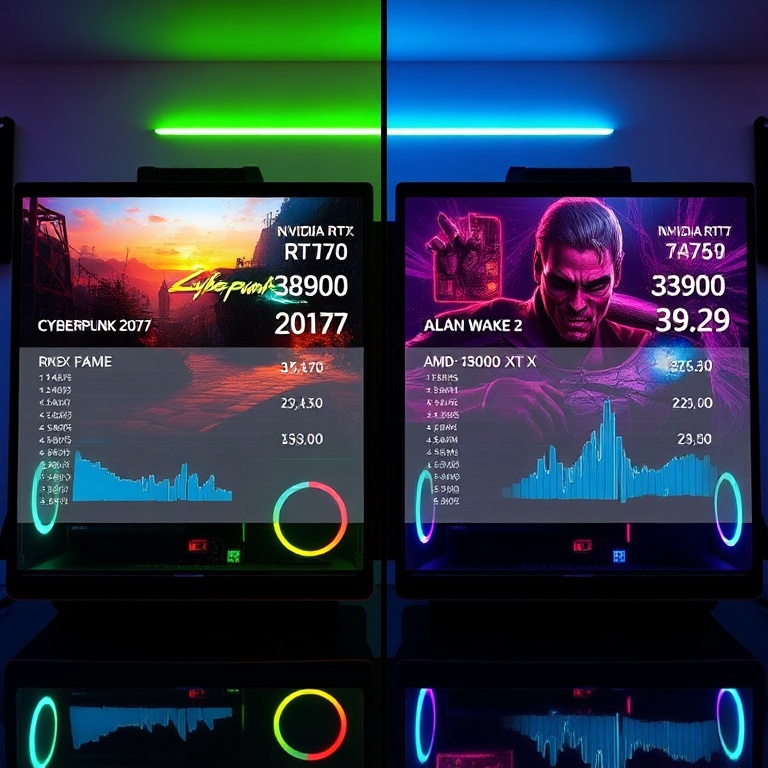
For instance, in titles like “Cyberpunk 2077” (without ray tracing), “Starfield,” and “Forza Horizon 5,” the RX 7800 XT typically delivered a few percentage points higher average FPS. This indicates strong traditional rendering capabilities, making it a formidable **New Gaming Gpu** for those prioritizing maximum frame rates in non-RT titles. However, the 4070 Super was never far behind, often within a margin of error.
Ray Tracing Performance: Where Lights Get Real
Ray tracing is arguably the most demanding graphical feature in modern games, simulating how light behaves in the real world. NVIDIA has traditionally held a significant lead in this department, and the RTX 4070 Super continues this trend. With its dedicated RT Cores and optimized architecture, it generally outperforms the RX 7800 XT in ray-traced scenarios.
In games like “Alan Wake 2,” “Cyberpunk 2077” (with RT enabled), and “Control,” the RTX 4070 Super provided noticeably smoother gameplay, often maintaining higher average and 1% low FPS when ray tracing was cranked up. While the RX 7800 XT has improved its ray tracing capabilities significantly over previous generations, it still struggles to match NVIDIA’s specialized hardware. If ray tracing is a must-have for your **New Gaming Gpu**, NVIDIA currently holds the advantage.
Upscaling Technologies: DLSS 3.5 vs. FSR 3 for a Better New Gaming Gpu Experience
Upscaling technologies have become indispensable for achieving high frame rates at demanding resolutions and settings. Both NVIDIA and AMD offer their proprietary solutions, and understanding their differences is key to evaluating overall performance.
NVIDIA’s DLSS (Deep Learning Super Sampling) is now in its 3.5 iteration, incorporating Frame Generation and Ray Reconstruction. DLSS 3.5, particularly with Frame Generation, can dramatically boost FPS by inserting AI-generated frames between traditionally rendered ones. This technology is highly effective, often delivering significant performance gains with excellent image quality. The adoption rate for DLSS is also very strong across many AAA titles, making this **New Gaming Gpu** very versatile.
AMD’s FSR (FidelityFX Super Resolution) is an open-source alternative, now at FSR 3, which also includes its own Frame Generation technology. FSR 3 offers broader compatibility, working on a wider range of GPUs, including older AMD cards and even NVIDIA cards. While FSR has made great strides in image quality, many critics still find DLSS 3.5, especially with Ray Reconstruction, to offer a slightly superior visual output, particularly in motion. The adoption of FSR 3’s Frame Generation is still catching up to DLSS 3’s widespread implementation.
Power Consumption and Thermals
Efficiency matters, not just for your electricity bill but also for system noise and cooling requirements. The RTX 4070 Super typically operates with a Total Graphics Power (TGP) of around 220W, making it a relatively power-efficient card for its performance tier. This means it can often be adequately cooled with less aggressive fan curves, leading to quieter operation.
The RX 7800 XT, with a TBP (Total Board Power) of 263W, draws more power than its NVIDIA counterpart. While not excessively high, this translates to slightly more heat generation and potentially louder fan noise under load. Both cards, however, generally stay within acceptable thermal limits with standard cooling solutions, but the NVIDIA card offers a bit more headroom for quiet operation, which can be a deciding factor for some looking for a quiet **New Gaming Gpu**.
Beyond Benchmarks: New Gaming Gpu Features and Ecosystems
Performance numbers only tell part of the story. Both NVIDIA and AMD offer a suite of features and software ecosystems that enhance the gaming and overall PC experience. These can often tip the scales for users with specific needs or preferences.
NVIDIA’s Comprehensive Ecosystem
NVIDIA’s ecosystem extends beyond just DLSS. Features like NVIDIA Reflex reduce system latency, providing a competitive edge in fast-paced games. NVIDIA Broadcast offers AI-powered tools for streamers and content creators, including noise removal and virtual backgrounds. CUDA cores also provide powerful acceleration for professional applications, making an NVIDIA **New Gaming Gpu** appealing to those who blend work and play.
NVIDIA’s driver support is generally considered robust, with frequent updates and strong Day-0 game readiness. Their GeForce Experience software provides easy driver updates, game optimization, and recording tools. For users deeply invested in the NVIDIA ecosystem, these features add significant value.
AMD’s Open Approach and Adrenalin Software
AMD’s approach often emphasizes openness and broader compatibility. FSR, as mentioned, works across a wider range of hardware. AMD Anti-Lag and Radeon Boost are similar to NVIDIA Reflex, aiming to reduce latency and improve responsiveness. The Adrenalin Software suite is a comprehensive control panel for managing GPU settings, monitoring performance, and accessing features like Radeon Chill and Image Sharpening.
AMD has also made great strides in driver stability and performance optimization, consistently improving with each release. For users who prefer a more open platform or have a mixed hardware setup, a **New Gaming Gpu** from AMD offers compelling flexibility and value, often providing strong performance for the money without locking into a proprietary ecosystem.
The Value Equation: Is a New Gaming Gpu Worth It?
Ultimately, the decision to upgrade often comes down to budget and perceived value. Both the RTX 4070 Super and the RX 7800 XT launched at competitive price points, typically hovering around the $599-$649 USD mark. However, market prices can fluctuate, so always check current retail listings.
The RX 7800 XT often presents a slightly better performance-per-dollar ratio in raw rasterization, especially if you can find it closer to its MSRP. Its larger VRAM buffer also offers a degree of future-proofing, which is appealing as game textures continue to grow in size and complexity. For a **New Gaming Gpu** focused on pure gaming performance at 1440p without heavy ray tracing, it’s a very strong contender.
The RTX 4070 Super, while sometimes slightly more expensive, justifies its price with superior ray tracing performance, the mature and highly effective DLSS 3.5, and the broader NVIDIA ecosystem. If you prioritize cutting-edge graphical effects, excellent upscaling, and robust content creation features, the additional investment might be well worth it. Consider what aspects of your gaming experience you value most when weighing the cost.
Who Should Upgrade?
Deciding if a **New Gaming Gpu** is right for you depends heavily on your current hardware and gaming habits.
If you’re upgrading from an older generation card, such as an NVIDIA RTX 20-series or AMD RX 5000-series (or anything older), both the RTX 4070 Super and RX 7800 XT will offer a truly transformative experience. You’ll see massive gains in frame rates, allowing you to play modern titles at 1440p with high or max settings, something your old card simply couldn’t handle.
If you currently own an RTX 3070/3070 Ti or an RX 6700 XT/6800, the upgrade is less dramatic but still noticeable. The 4070 Super offers a more compelling jump, especially with DLSS 3.5 Frame Generation, while the 7800 XT provides a solid incremental gain in rasterization. For these users, consider if your current card is struggling with your favorite games or if you truly desire higher frame rates for high-refresh-rate monitors.
Ultimately, your choice between these two excellent cards will boil down to priorities. Do you value raw rasterization and VRAM, or superior ray tracing and AI upscaling? Both deliver a fantastic 1440p gaming experience, making either a solid choice for a **New Gaming Gpu**.
Final Verdict: The New Gaming Gpu Landscape
Both the NVIDIA RTX 4070 Super and the AMD RX 7800 XT are exceptional graphics cards that solidify their positions as prime choices for 1440p gaming. They represent the current sweet spot for performance, offering a balance of power and price that makes them highly attractive to a wide range of gamers. The question of “Is It Worth the Upgrade?” is met with a resounding “Yes” for anyone coming from an older generation, and a nuanced “It depends” for those with more recent, but still last-gen, hardware.
The RTX 4070 Super shines brightest in games leveraging ray tracing and benefits immensely from NVIDIA’s mature and powerful DLSS 3.5 technology. Its efficiency and ecosystem features are also strong selling points. The RX 7800 XT, on the other hand, often edges out the 4070 Super in traditional rasterization, offers more VRAM, and typically comes at a slightly more aggressive price point, making it a fantastic value proposition for pure gaming horsepower.
Ultimately, there’s no single “best” card; only the best card for your specific needs and preferences. Evaluate your budget, the types of games you play, and whether features like ray tracing and advanced upscaling are critical to your experience. Whichever you choose, you’ll be getting a powerful **New Gaming Gpu** capable of delivering an incredible gaming experience for years to come.
What’s your take on these new GPUs? Are you planning an upgrade, or do you think your current card still holds its own? Share your thoughts and experiences in the comments below!



Leave a Comment